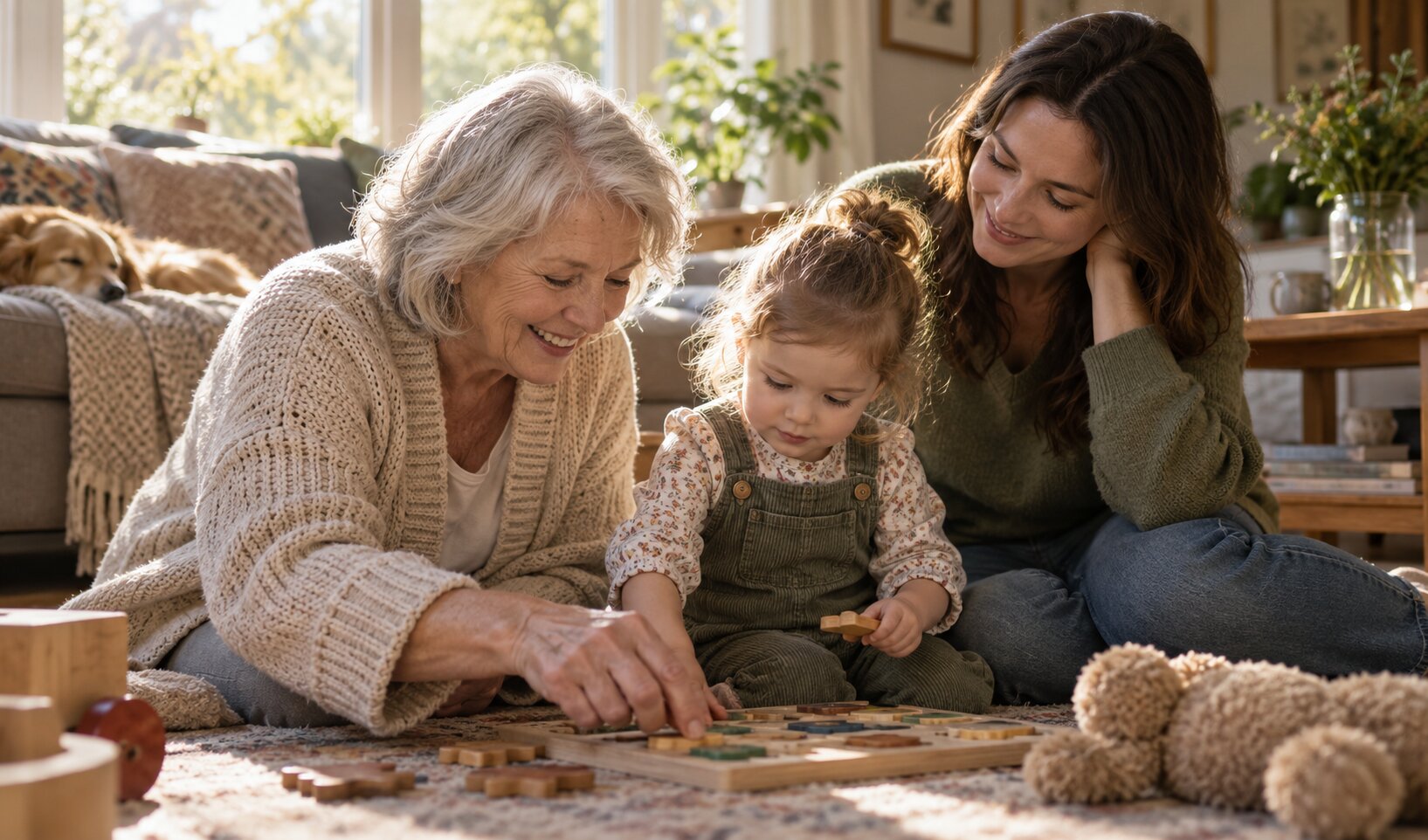
Grandparents frequently love their grandchildren equally—but across large populations, their average investment is not always equal.
Studies in several Western societies often find a recurring pattern: maternal grandmothers provide the most contact and care, while paternal grandfathers provide the least. Maternal grandfathers and paternal grandmothers usually fall somewhere between them.
One evolutionary explanation is parentage certainty. A mother can be certain that she gave birth to her child. Historically, however, biological fatherhood could never be equally certain. A maternal grandmother therefore has no uncertain paternal link connecting her to a grandchild. A paternal grandfather has two: whether he fathered his son and whether that son fathered the grandchild.
Natural selection could theoretically have favored small, unconscious differences in investment according to these probabilities. This does not mean grandparents consciously question anyone’s parentage.
The strongest evidence comes from large European family surveys. Maternal grandparents were generally more likely than paternal grandparents to provide childcare. Researchers also found that paternal grandmothers invested more when they lacked grandchildren through their own daughters—a more certain alternative investment opportunity. European study
Well supported: average grandparental involvement often differs by lineage, with maternal grandmothers commonly the most involved.
Plausible but debated: inherited sensitivity to genetic certainty causes this pattern. Mothers often maintain family relationships, live closer to their own parents and control grandparents’ access to children. Divorce, health, wealth, culture and relationship quality may explain much of the difference.
Evolution may contribute to the pattern—but family structure determines how it appears in real life.


