Corruption is sometimes described as a problem of dishonest politicians taking bribes. But its real damage goes much deeper.
Corruption is essentially a hidden tax on an entire society. The money may disappear into the pockets of a few people, but the cost is eventually paid by everyone.
Imagine a government allocates $100 million to build hospitals, schools, roads, and water systems. If officials, contractors, and middlemen siphon away even 20% through kickbacks and inflated contracts, the country does not merely lose $20 million. It may end up with weaker bridges, poorly equipped hospitals, overcrowded schools, and unreliable infrastructure.
The damage compounds.
1. Corruption Rewards Connections Instead of Competence
In a healthy economy, the best-qualified company should win a government contract.
In a corrupt system, the contract may go to the company with the best political connections.
Eventually, talented entrepreneurs begin asking:
“Why should I innovate if success depends on whom I know?”
When relationships become more important than merit, productivity suffers.
2. Corruption Discourages Investment
Businesses like predictability.
If an entrepreneur must secretly pay officials to obtain permits, clear customs, receive electricity, or enforce contracts, doing business becomes expensive and uncertain.
Investors may simply take their money elsewhere.
The country then loses not only investment, but also factories, technology, jobs, tax revenue, and economic growth.
3. Corruption Makes the Poor Pay More
Wealthy people can often navigate corrupt systems using money and connections.
Poor families cannot.
A bribe for a hospital bed, government certificate, school admission, police service, or welfare benefit can be devastating to someone living on a small income.
That is why corruption often functions like a regressive tax — hurting the poorest citizens the most.
4. Corruption Destroys Trust
Perhaps the greatest damage is psychological.
When people repeatedly see corrupt officials becoming wealthy while honest citizens struggle, they begin losing faith in the system.
They start thinking:
“Why should I follow the rules when nobody else does?”
Once that attitude spreads, tax evasion, bribery, cheating, favoritism, and political cynicism can become normalized.
A country cannot function efficiently when millions of people believe the rules are meaningless.
5. Corruption Creates a Vicious Cycle
Corruption also feeds itself.
A politician may spend enormous amounts of money winning an election. Once in power, that politician may feel pressure to recover the money through contracts, favors, and kickbacks.
That money can then finance the next election.
Politics becomes less about public service and more about controlling access to government resources.
The Real Cost of Corruption
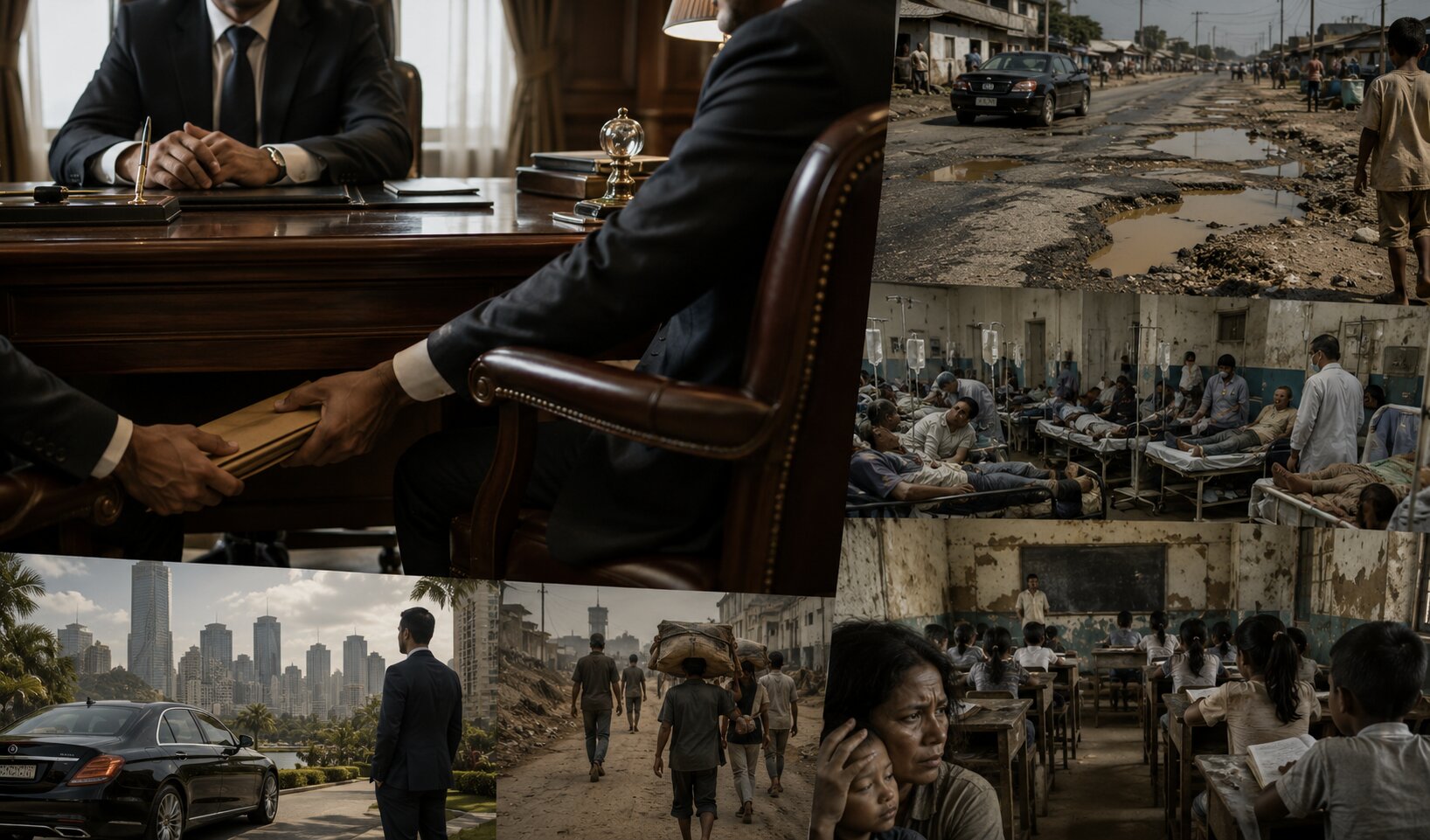
The tragedy of corruption is that its victims are often invisible.
It is the child studying in a poorly funded school.
The patient waiting in an understaffed hospital.
The commuter driving on a badly constructed road.
The entrepreneur who gives up because obtaining a permit requires a bribe.
And the talented young person who leaves the country because merit seems less important than connections.
Corruption therefore does more than steal money.
It steals opportunity.
A country becomes prosperous when people believe that hard work, talent, entrepreneurship, and honesty can lead to success. When corruption replaces those principles with bribery, favoritism, and political connections, a nation slowly weakens from within.
The strongest countries are not necessarily those with the most natural resources.
They are often the countries where institutions are trusted, rules are predictable, public money is protected, and ordinary people believe the system gives them a fair chance.