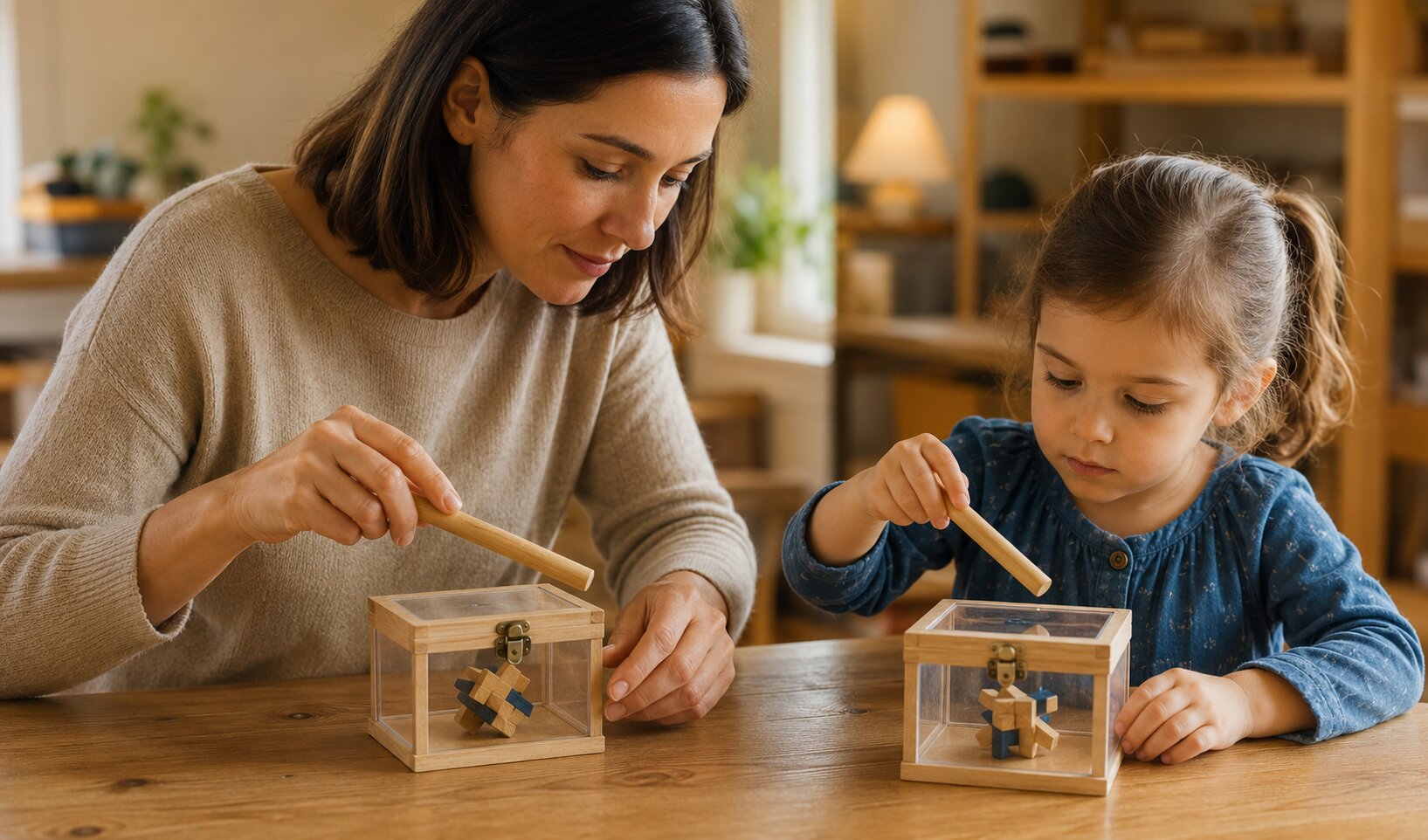
Show a child how to open a box, but first tap it three times and draw a circle in the air. The tapping and circling accomplish nothing—yet the child may carefully repeat them.
Psychologists call this overimitation: copying not merely another person’s goal, but the exact sequence used to achieve it.
In a classic experiment, three- and four-year-old children and young chimpanzees watched an adult retrieve food from a puzzle box using both necessary and unnecessary actions. When the box was opaque, both species copied the sequence. When it was transparent—making the useless steps visibly pointless—chimpanzees skipped them, while children generally continued performing them. Comparative study
This tendency is not confined to Western classrooms. Children in remote Kalahari communities copied causally irrelevant actions at rates broadly comparable to urban Australian children, suggesting that overimitation is widespread across human cultures. Cross-cultural study
Well supported: young children frequently reproduce unnecessary demonstrated actions, especially when an adult appears intentional, knowledgeable or instructional.
Plausible but debated: natural selection favored high-fidelity copying because children cannot always identify which steps matter. Treating every action as important may waste effort—but it also prevents a learner from accidentally omitting a hidden step in toolmaking, food preparation, medicine or ritual. This copying bias could therefore help preserve complex cultural knowledge across generations.
However, children are selective imitators, not mindless copying machines. They adjust their behavior according to the model, context and apparent social rules.
What looks like inefficient learning may be part of humanity’s cultural superpower: copy first, understand later—and improve it eventually.


