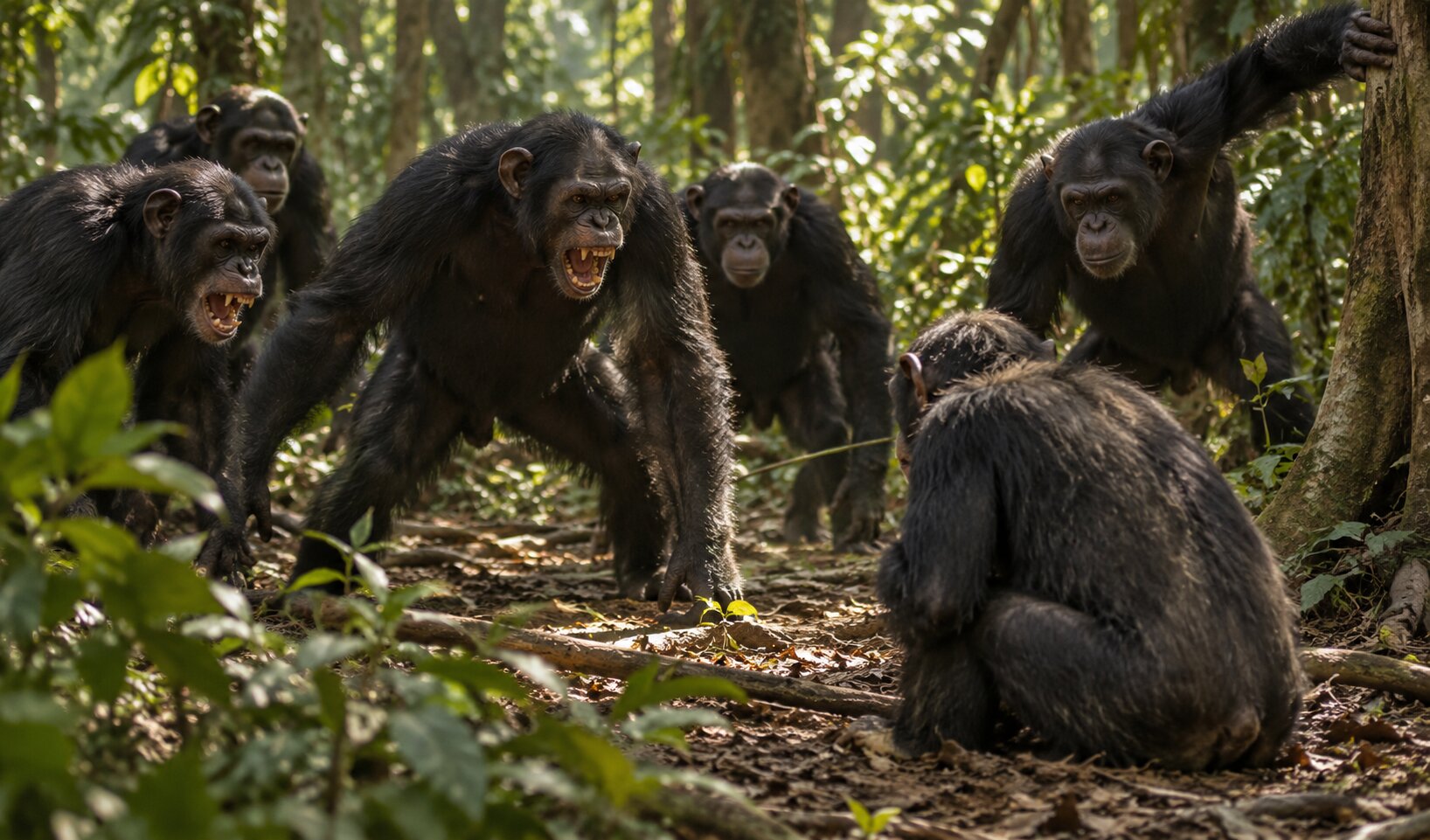
Chimpanzees are often described as our closest living relatives, but some of their behavior can be disturbingly familiar.
Researchers have observed groups of chimpanzees deliberately isolating, surrounding, and killing other chimpanzees. Sometimes the victim belongs to a neighboring community. In rarer cases, several members of the same group turn on one of their own.
This is not simply random aggression. In many cases, it is coalitionary killing—multiple individuals cooperating to attack a single target.
And that raises an uncomfortable evolutionary question:
If both humans and chimpanzees practice coalitionary killing, did our common ancestors do it too?
The answer is: quite possibly—but proving it is much harder than it first appears.
Chimpanzees Are Highly Political Animals
Chimpanzee society is built around alliances, competition, rank, territory, and reproductive opportunities.
Adult males form coalitions with one another. These alliances can help them rise in social rank, challenge dominant males, defend territory, and compete against neighboring groups.
This means chimpanzee aggression is often not merely individual.
It can be political.
Several males may cooperate against another chimpanzee when doing so improves their chances of success.
Researchers have documented groups of males quietly patrolling territorial boundaries. If they encounter a lone chimpanzee from another community, they may surround and attack him.
The numerical imbalance matters.
Chimpanzees appear especially willing to attack when the risk to themselves is low—perhaps six or eight attackers against one isolated individual.
This idea is sometimes described as the imbalance-of-power hypothesis.
In simple terms:
Attack when your side is overwhelmingly stronger than the opponent.
That principle sounds remarkably familiar because humans often behave similarly during warfare and intergroup conflict.
Why Would Chimpanzees Kill Other Chimpanzees?
There are several possible evolutionary benefits.
Territorial Expansion
Chimpanzee communities defend territories containing food, nesting areas, and females.
Repeatedly killing males from a neighboring community can weaken that community.
Over time, the stronger group may expand its territory.
More territory can mean more food and potentially more reproductive opportunities.
From an evolutionary perspective, coalitionary aggression can therefore provide tangible benefits.
Reproductive Competition
Removing rival males can reduce competition for females.
Territorial expansion may also bring females from neighboring groups into contact with the victorious males.
This means that lethal aggression can indirectly increase reproductive success.
Dominance Politics
Chimpanzees also compete intensely within their own communities.
An alpha male does not rule simply because he is physically strongest. He often remains dominant because he maintains alliances.
A powerful male who loses political support may suddenly become vulnerable.
Several males may cooperate against him, and occasionally these attacks become lethal.
Chimpanzee dominance therefore resembles politics more than simple brute force.
Power depends heavily on coalition building.
Infanticide
Chimpanzees also sometimes kill infants.
The evolutionary explanations vary depending on the circumstances, but reproductive competition is often involved.
For males, killing an unrelated infant may cause the mother to become reproductively available sooner.
Female chimpanzees have also occasionally participated in infanticide, though their motivations may involve competition over resources or social position.
Coalitionary Killing Is Not Unique to Chimpanzees
Chimpanzees are not the only animals that engage in coordinated lethal aggression against members of their own species.
Several highly social animals display similar behavior.
| Species | Typical Form of Coalitionary Violence |
|---|---|
| Humans | Warfare, raids, executions, mob violence |
| Chimpanzees | Territorial raids and attacks on isolated rivals |
| Wolves | Packs attack and kill members of neighboring packs |
| Lions | Male coalitions kill rival males and frequently kill cubs |
| Spotted hyenas | Clans engage in coordinated territorial battles |
| Bottlenose dolphins | Male alliances violently attack rival dolphins |
| Meerkats | Groups fight neighboring groups and may kill rivals |
| Banded mongooses | Groups engage in organized intergroup battles |
| Some monkeys | Coalitions attack rivals during dominance conflicts |
| Ants | Colonies conduct enormous territorial wars |
The details differ enormously, but the underlying logic is often similar:
Cooperation within the group allows individuals to defeat competitors outside the group.
This creates an evolutionary paradox.
The same capacity for cooperation that produces extraordinary social organization can also produce extraordinary violence.
Mobbing Is Not Always Killing
It is important to distinguish coalitionary killing from another common animal behavior called mobbing.
Crows, small birds, monkeys, and many other animals will collectively harass predators such as hawks, owls, or snakes.
The goal is usually defensive.
They are trying to drive the predator away.
Coalitionary killing is different.
Here, animals cooperate to attack members of their own species, often over territory, dominance, reproduction, or resources.
Chimpanzee territorial raids fall into this second category.
The Evolutionary Question
Humans and chimpanzees last shared a common ancestor roughly six to eight million years ago.
Both species today demonstrate something striking:
They can form coalitions and cooperate to kill members of their own species.
This naturally suggests an evolutionary possibility.
Perhaps the common ancestor of humans and chimpanzees already possessed this behavior.
If so, coalitionary violence would be far older than civilization, agriculture, organized armies, or even the human species itself.
The psychological machinery underlying warfare may therefore have very ancient roots.
But scientists must be careful.
Shared behavior does not automatically prove that the common ancestor possessed that behavior.
There are several possibilities.
Possibility One: The Common Ancestor Practiced Coalitionary Killing
Under this scenario, the behavior evolved before humans and chimpanzees separated.
Both lineages inherited the underlying psychology.
Humans later transformed small-scale coalitionary aggression into raids, tribal warfare, armies, and eventually nation-state warfare.
Chimpanzees retained a smaller-scale version involving territorial patrols and group attacks.
This is certainly possible.
Possibility Two: Humans and Chimpanzees Evolved It Independently
Evolution frequently produces similar solutions to similar problems.
For example, wings evolved independently in birds, bats, and insects.
Something similar could have occurred with coalitionary aggression.
Highly social species competing over territory and reproduction may independently evolve coordinated violence.
Humans and chimpanzees might therefore have developed coalitionary killing separately after their evolutionary lineages diverged.
Possibility Three: The Ancestor Had the Capacity, but Not Necessarily the Modern Behavior
This may be the most cautious interpretation.
The common ancestor could have possessed the psychological ingredients necessary for coalitionary aggression:
- strong group loyalty
- male alliances
- territoriality
- dominance competition
- awareness of numerical advantage
- recognition of outsiders
- coordinated aggression
These traits could later have developed differently in different ape species.
Under this view, our ancestor may not have conducted organized lethal raids exactly like modern chimpanzees.
But the basic cognitive and emotional machinery may already have existed.
Why Bonobos Complicate the Story
There is another important clue.
Bonobos are just as closely related to humans as chimpanzees are.
Chimpanzees and bonobos separated from each other long after their lineage had already separated from ours.
Yet bonobo societies generally show much lower levels of lethal intergroup aggression.
Bonobos still compete, form alliances, and sometimes fight, but their social structure is considerably more tolerant.
This complicates attempts to reconstruct ancestral behavior.
If chimpanzees, bonobos, and humans all descended from a shared ancestor, why are their societies so different?
The answer is that evolution does not preserve behavior unchanged.
Ecology, food distribution, mating systems, social structure, and demographic pressures can profoundly reshape behavior.
Even closely related species can follow very different evolutionary paths.
Why We Cannot Find the Answer Easily in Fossils
Bones fossilize.
Behavior usually does not.
We can examine ancient skulls, teeth, tools, and skeletons. Occasionally we can identify injuries caused by weapons or violence.
But we cannot directly observe how an ape community behaved seven million years ago.
This is why scientists use comparative evolutionary reasoning.
They examine living species, reconstruct family relationships, study ecology, and ask which behaviors are most likely to have existed in ancestral populations.
The conclusions are probabilistic rather than certain.
The Deeper Human Connection
What makes chimpanzee behavior especially fascinating is that their violence depends on something we usually consider positive:
cooperation.
A lone chimpanzee cannot easily defeat several rivals.
But a coalition can.
The same evolutionary ability that allows individuals to cooperate against enemies also makes possible extraordinary cooperation within groups.
Humans expanded this capacity dramatically.
We cooperate with thousands or even millions of strangers.
We build cities.
We maintain governments.
We create scientific institutions.
We organize disaster relief.
We build armies.
All of these rely on an extraordinary ability to coordinate around shared goals.
Human cooperation therefore has two faces.
One allows people to cooperate with others.
The other allows people to cooperate against others.
Tribalism May Be Older Than Humanity
Humans have an unusually strong tendency to divide the social world into groups.
Us and them.
Family and stranger.
Tribe and outsider.
Nation and enemy.
Religion and unbeliever.
Political party and opposition.
Sports team and rival.
Modern culture can create these identities almost instantly, but the psychological tendency may be extremely ancient.
For millions of years, survival likely depended heavily on belonging to a group.
Individuals protected by strong coalitions were more likely to survive territorial conflict, resource competition, and attacks from outsiders.
Natural selection may therefore have favored both:
cooperation toward insiders and suspicion toward outsiders.
Chimpanzee societies show a primitive version of this pattern.
Does This Mean War Is Inevitable?
No.
Evolutionary explanations describe tendencies, not destiny.
Humans inherited many ancient impulses that culture can strengthen, suppress, or redirect.
Aggression is one example.
Cooperation is another.
Empathy is another.
Humans routinely cooperate peacefully with individuals they have never met.
International trade, scientific collaboration, humanitarian organizations, diplomacy, and global communication all demonstrate that our social psychology is remarkably flexible.
The same brain capable of tribal warfare can expand the definition of “our group” from a family to a village, a nation, or even humanity itself.
That flexibility may be one of the most important characteristics of our species.
An Ancient Shadow
Chimpanzee coalitionary killing forces us to reconsider the origins of organized violence.
War did not necessarily begin when humans invented agriculture.
Coalitionary aggression may have roots stretching millions of years deeper into our evolutionary past.
We cannot confidently say that the common ancestor of humans and chimpanzees routinely conducted lethal raids.
But it is reasonable to suspect that it possessed at least some of the psychological foundations necessary for coalitionary aggression.
And those foundations—alliances, territoriality, group loyalty, dominance competition, and sensitivity to numerical advantage—remain deeply recognizable today.
Perhaps the most unsettling lesson from chimpanzees is not simply that they sometimes behave like us.
It may be that, in certain situations, we are still behaving like them.


