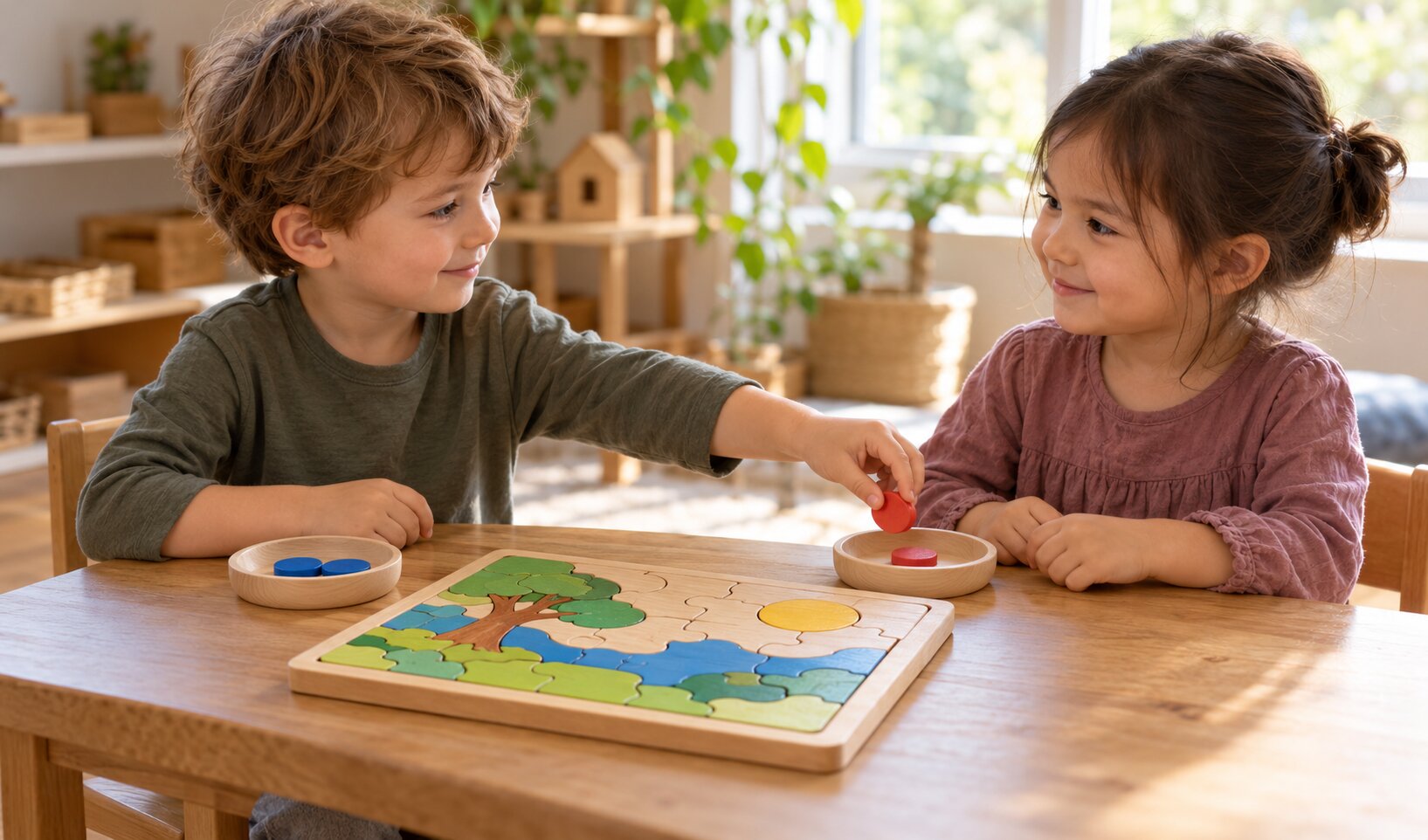
Imagine two children receiving prizes. Now imagine those same children working together to obtain them. Does the shared effort change what feels fair?
A 2011 experiment suggests it can. Children around three years old divided rewards more equally after collaborating than after receiving a windfall or working separately alongside one another. Chimpanzees tested in comparable situations did not show the same collaboration-linked increase in sharing. Research study. PubMed
The important distinction was not simply possession. It was how the rewards had been obtained: “mine” versus “something we produced together.”
Supported by the experiment: joint work can encourage equitable sharing in young children. This does not mean that three-year-olds are consistently generous—or that chimpanzees never cooperate. The finding concerns a particular change in sharing after collaboration.
Plausible but debated: human fairness partly evolved because our ancestors depended on productive partners. Someone who repeatedly monopolized jointly obtained food might lose willing collaborators. Sharing the proceeds could therefore help sustain relationships essential to future success.
But the experiment cannot establish that evolutionary history. Children already have experience with adult expectations, ownership and sharing rules. Learned norms and evolved social capacities need not be competing explanations.
The intriguing possibility is that fairness begins not only with “Everyone deserves the same,” but with something more specific: “You helped make this happen—so you deserve a share.”


