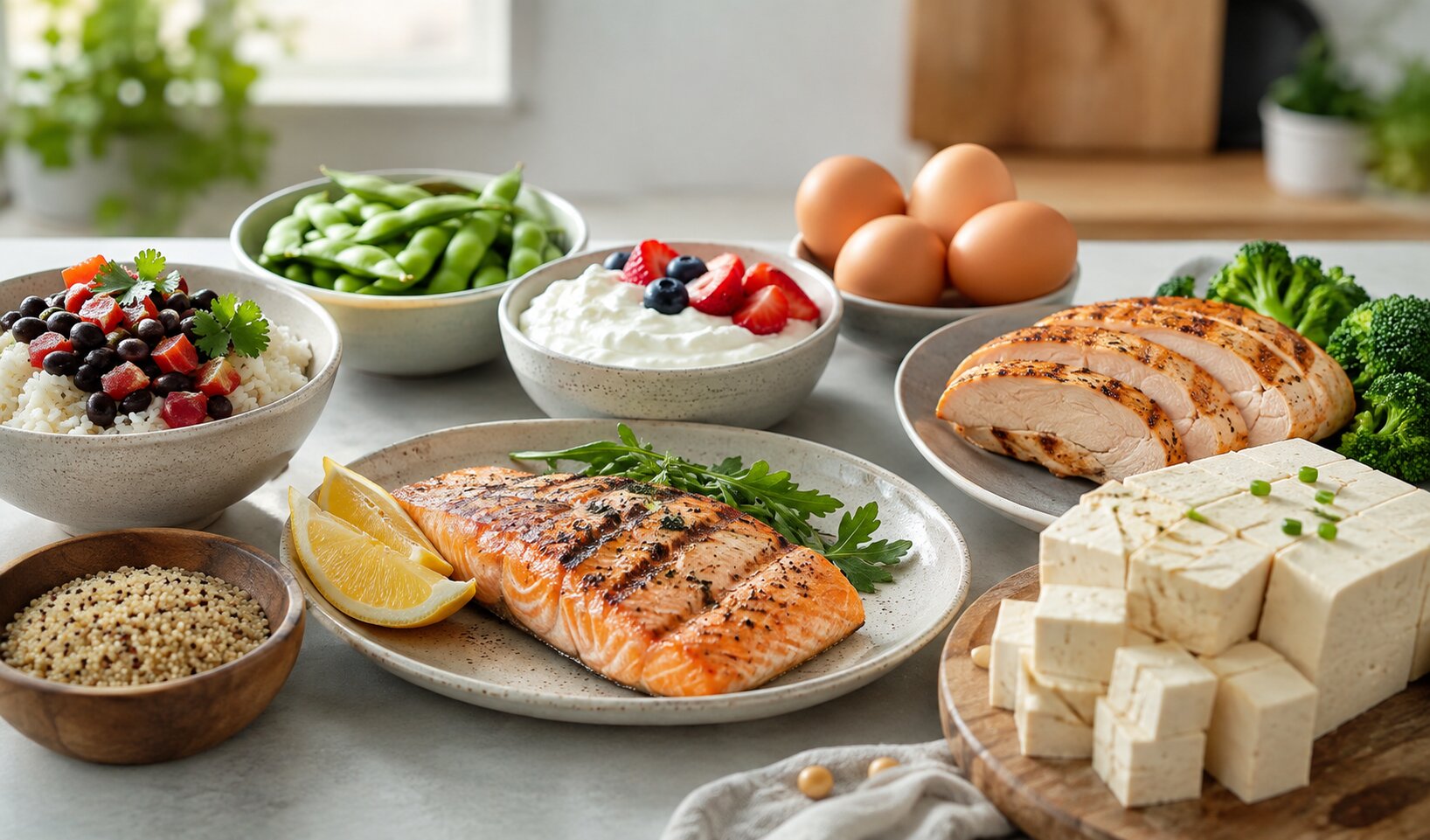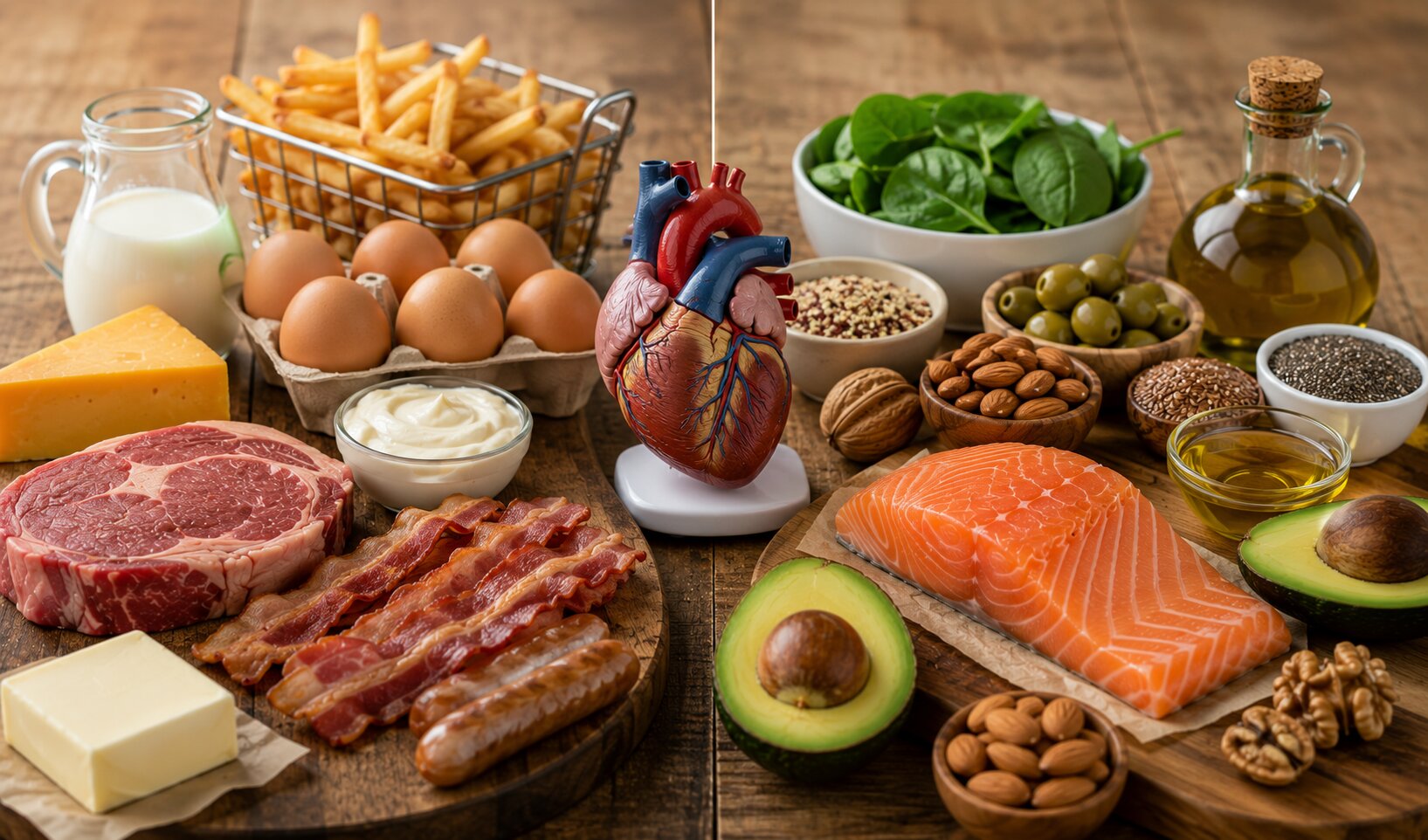
“My cholesterol is high. I should stop eating fat.”
Millions of people say this every year.
It sounds logical. After all, if fat is bad and cholesterol is bad, they must be the same thing, right?
Actually, they’re completely different.
Understanding the difference isn’t just an interesting biology lesson—it could change the way you think about food, weight loss, and heart health.
Let’s clear up one of the biggest misconceptions in nutrition.
Fat Is Fuel. Cholesterol Is a Building Material.
Imagine your body is a city.
Every city needs fuel to power its vehicles and factories. It also needs bricks, steel, and concrete to build homes, roads, and bridges.
In your body:
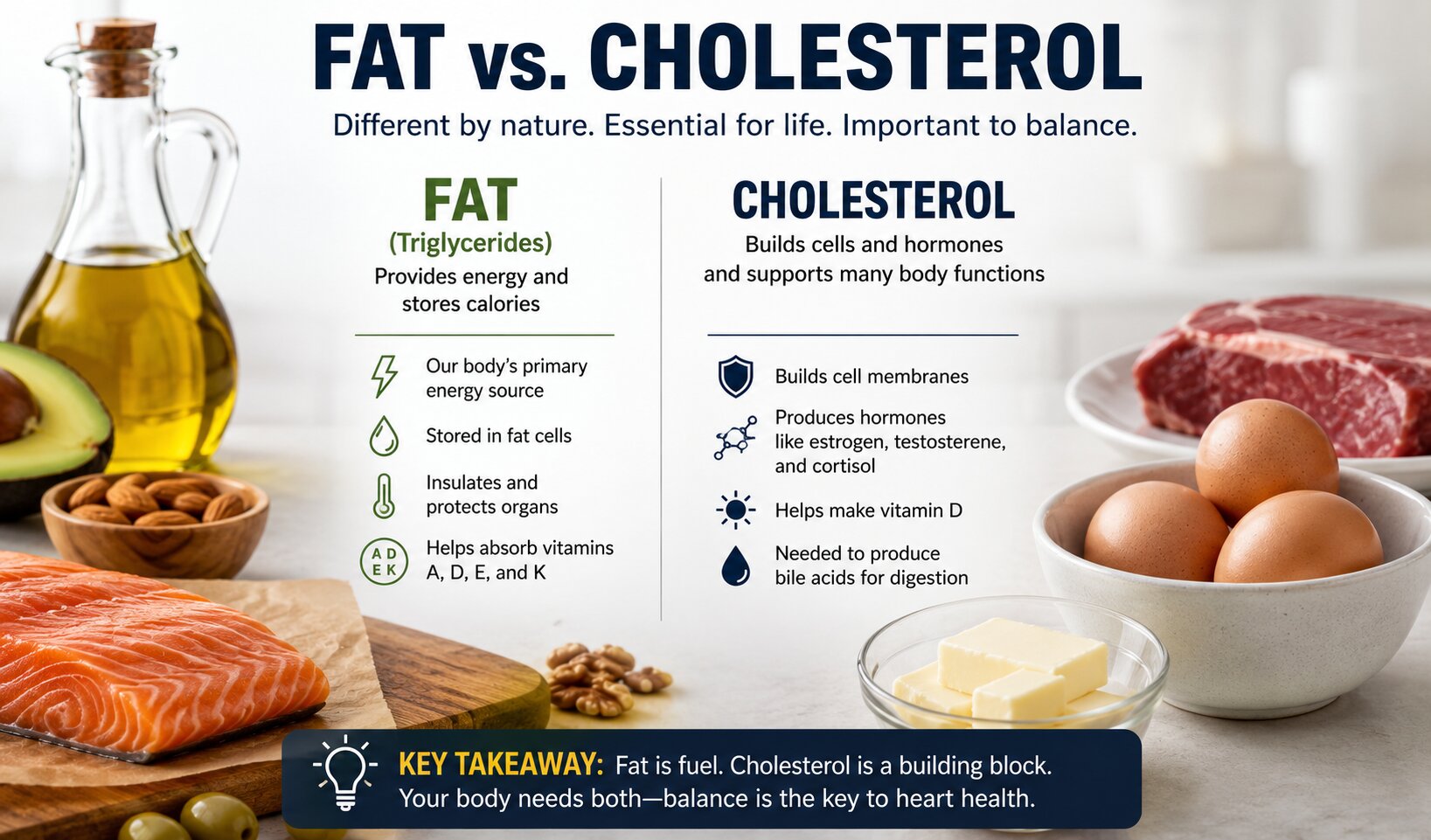
- Fat is the fuel.
- Cholesterol is the construction material.
Both are essential.
The problem begins only when there is too much of either in the wrong place.
What Exactly Is Fat?
Dietary fat is one of the three major nutrients your body needs, along with carbohydrates and protein.
Its primary jobs include:
- Providing energy
- Storing extra calories for later use
- Protecting your organs
- Keeping you warm
- Helping absorb vitamins A, D, E, and K
- Building healthy cell membranes
Whenever you eat more calories than your body burns, the excess is usually converted into triglycerides, which are stored inside fat cells.
Think of body fat as your body’s savings account.
Whenever food becomes scarce—or you simply skip a meal—your body withdraws energy from that account.
Then What Is Cholesterol?
Cholesterol is completely different.
It isn’t stored to provide energy.
Instead, your body uses cholesterol to:
- Build every cell membrane
- Produce hormones such as testosterone, estrogen, and cortisol
- Manufacture vitamin D
- Create bile acids that digest fats
In fact, cholesterol is so important that your liver manufactures most of what your body needs, even if you eat almost no cholesterol at all.
That’s why cholesterol isn’t your enemy.
It’s actually essential for life.
So Why Does Cholesterol Get Such a Bad Reputation?
Because cholesterol has to travel through your bloodstream.
Since cholesterol doesn’t dissolve in water, your body packages it into tiny particles called lipoproteins.
The two most well-known are:
LDL (Low-Density Lipoprotein)
Often called “bad cholesterol.”
LDL carries cholesterol from the liver to the rest of the body.
The problem isn’t LDL itself.
The problem arises when there’s too much LDL, allowing cholesterol to accumulate inside artery walls over many years.
This buildup can eventually narrow arteries and increase the risk of heart attacks and strokes.
HDL (High-Density Lipoprotein)
Known as “good cholesterol.”
HDL acts like a cleanup crew.
It collects excess cholesterol from tissues and blood vessels and transports it back to the liver, where it can be recycled or removed.
A healthy balance between LDL and HDL is one of the keys to cardiovascular health.
Not All Fat Is the Same
Another common misconception is believing all fats are unhealthy.
Nothing could be further from the truth.
Healthy Unsaturated Fats
These include:
- Olive oil
- Avocados
- Almonds
- Walnuts
- Salmon
- Sardines
- Flaxseeds
- Chia seeds
These fats can actually improve cholesterol levels and support heart health.
Less Healthy Saturated Fats
Found mainly in:
- Butter
- Fatty cuts of red meat
- Full-fat dairy
- Processed meats
Eating large amounts of saturated fat can raise LDL cholesterol in many people.
Trans Fats
These are the fats you should avoid whenever possible.
They raise LDL while lowering HDL—a double hit to heart health.
Fortunately, many countries have dramatically reduced their use in processed foods.
Can You Eat Fat Without Raising Cholesterol?
Absolutely.
In fact, many healthy diets contain plenty of fat.
The Mediterranean diet, widely regarded as one of the healthiest eating patterns in the world, gets roughly 35–40% of its calories from fat.
The difference is where that fat comes from.
Olive oil and nuts behave very differently inside your body than deep-fried fast food.
Quality matters more than simply avoiding fat.
The Simple Analogy You’ll Never Forget
Think of your body like a house.
- Fat is the firewood stored in your garage.
- Cholesterol is the lumber used to build the house.
You need both.
Too little firewood leaves you without fuel.
Too little lumber means you can’t build or repair anything.
But piling excessive amounts in the wrong places eventually creates problems.
The Bottom Line
Fat and cholesterol may travel in the same nutritional conversations, but they perform very different jobs.
Fat is your body’s energy reserve.
Cholesterol is an essential building block for every cell, hormone, and vitamin D molecule your body makes.
The real goal isn’t eliminating either one.
It’s maintaining balance.
Choose healthy unsaturated fats more often, limit heavily processed foods and excessive saturated fats, stay physically active, and have your cholesterol checked regularly—especially if heart disease runs in your family.
When you understand the difference between fat and cholesterol, healthy eating becomes far less confusing—and much more empowering.
After all, knowledge is one of the best medicines your heart can receive.