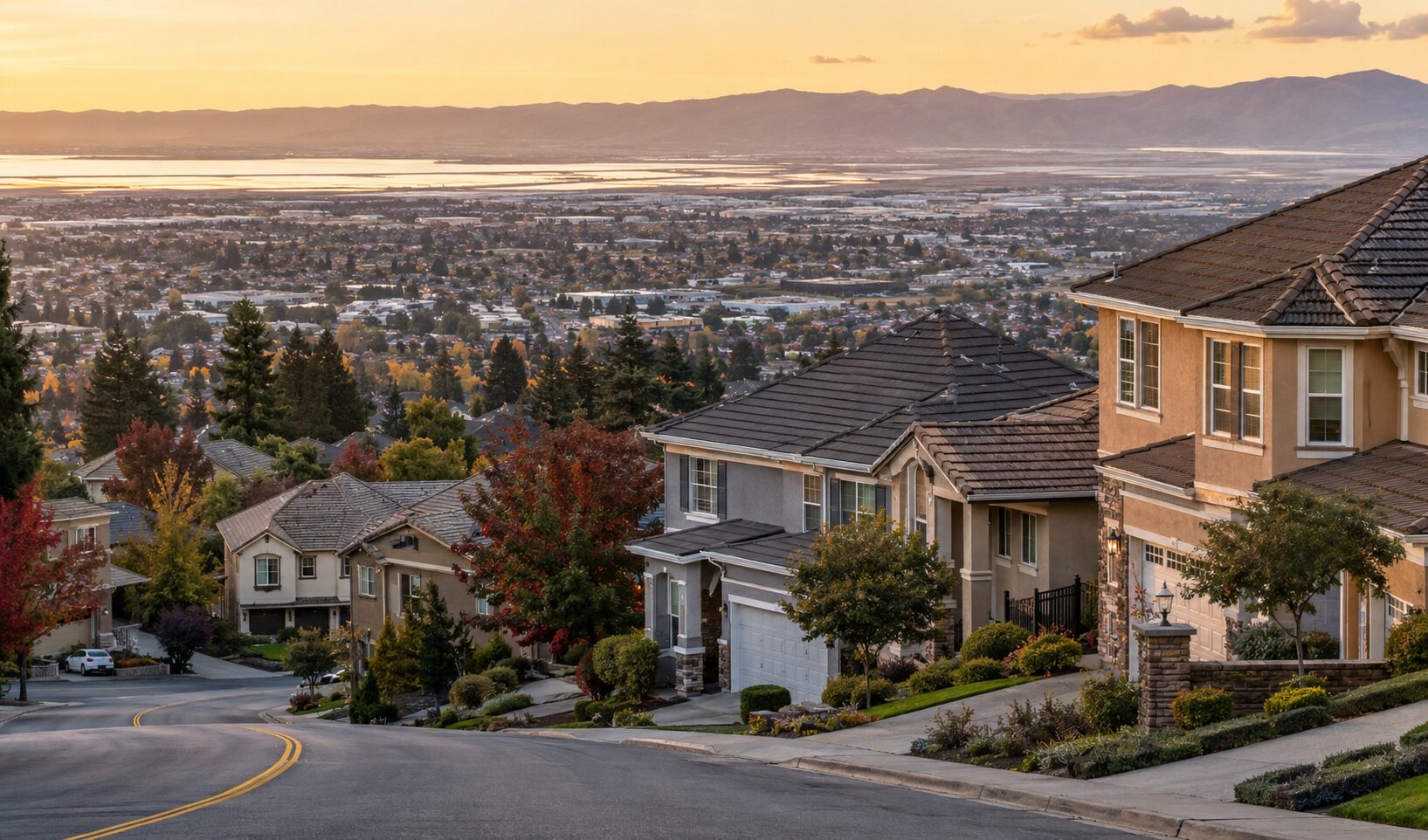
Here’s a breakdown of how the economics work in Fremont and the broader Bay Area, where median single-family home prices sit between $1.3M and $1.7M, along with where the housing market is headed long-term.
1. How People Afford $1M+ Homes
High Dual-Income Households
Fremont has one of the highest median household incomes in the nation, hovering around $181,000, with married family households averaging over $225,000–$270,000.
-
The Tech & Specialty Factor: Many buyers work in tech (Silicon Valley, SF, or local hubs like Tesla, Lam Research, and biotech), engineering, healthcare, or corporate management.
-
Dual Earners: When both partners earn $150k–$200k+, a combined household income of $300k–$400k+ makes a $1.2M–$1.5M mortgage manageable under standard lending guidelines.
Equity and Stock Compensation (RSUs)
Salary is often only part of the equation:
-
Restricted Stock Units (RSUs) & Capital Gains: Tech stock growth often supplies the bulk of the 20% ($250k–$300k+) down payment.
-
Rolling Over Existing Equity: A significant portion of buyers aren’t first-timers. They bought a condo or smaller townhome 5–10 years ago, built up $400k–$600k in equity, and rolled it directly into a single-family home.
Generational Wealth & Multi-Generational Living
-
Family Assistance: Down payment gifts or low-interest family loans are common among younger buyers competing in multiple-offer situations.
-
Shared Households: In cities like Fremont, multi-generational living is widely practiced. Combining income across three or four working adults in a single household makes a large mortgage far more attainable.
2. Does Pay Keep Up with Cost of Living?
It depends heavily on the industry:
| Income Tier | Has Pay Kept Up? | Impact |
| High Tech / Specialized | Yes | Total compensation (base + equity) has largely scaled with or outpaced housing appreciation over the past decade. |
| Middle Income / Public Sector | Partially | Teachers, nurses, municipal workers, and civil engineers face severe pressure. While salaries are higher than national averages, they haven’t grown at the same pace as home prices. |
| Service & Hourly Sector | No | Local pay has fallen far behind cost-of-living increases, making homeownership virtually impossible without inherited property or subsidies. |
3. Will Prices Fall to Meet Affordability?
Short answer: Unlikely.
A drastic price collapse to “nationally affordable” levels (e.g., $500k–$700k) is highly improbable due to structural economic drivers:
-
Severe Supply Deficit: The Bay Area has underbuilt housing relative to job growth for decades. Fremont is geographically bounded by the San Francisco Bay on one side and the Mission Peak hills on the other, limiting outward expansion.
-
The “Rate-Lock” Effect: Millions of current homeowners hold mortgages with interest rates around 2.5% to 3.5%. Selling to buy another home at current market rates means doubling their interest costs, so inventory remains extremely tight.
-
Prop 13 Stability: California’s Proposition 13 caps property tax increases based on the purchase price, not current market value. Longtime homeowners pay relatively low property taxes, removing the financial pressure to sell during downturns.
4. What Happens in the Long Term?
Rather than a market crash, the region is trending toward a three-part demographic shift:
A High-Income & Legacy Market
Cities like Fremont are increasingly populated by:
-
High-earning dual-income households (primarily tech, biotech, and executive roles).
-
Longtime homeowners who bought decades ago and benefit from low property tax bases.
-
Retirees and equity-rich households with fully paid-off mortgages.
Out-Migration of the Middle Class
Families in single-income or non-tech occupations who want standard single-family homes often migrate:
-
In-State: Moving east toward Tracy, Mountain House, Lathrop, Sacramento, or the Central Valley (accepting longer commutes).
-
Out-of-State: Relocating to lower-cost states like Texas, Washington, Arizona, or North Carolina.
Structural Shift Toward High-Density Housing
To counteract displacement, state legislation (such as SB 9, SB 35, and local transit-oriented zoning) is gradually reshaping Bay Area housing:
-
Condos, Townhomes, and ADUs: Single-family lots are increasingly adding Accessory Dwelling Units (ADUs), while central areas near BART stations are being rezoned for high-density condos and townhomes.
-
New Entry-Level Standards: For younger generations, the traditional entry point into homeownership in Fremont is shifting from detached single-family houses to condos and townhomes.