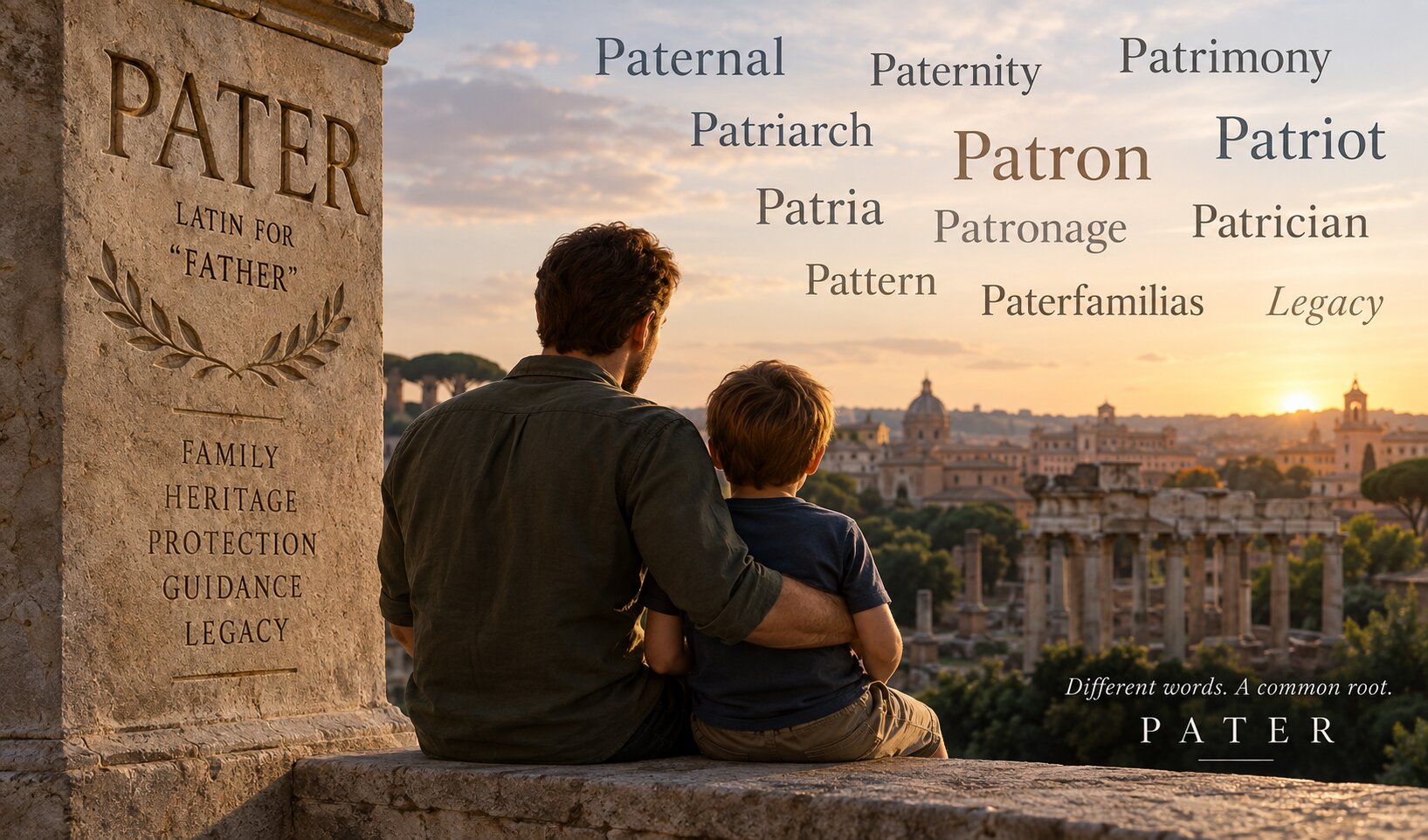
The Latin pater means “father.” It produced the stems pater-, patr-, and indirectly patron- in English.
Here are some important descendants:
| Word | Origin / Literal idea | Modern meaning |
|---|---|---|
| Paternal | paternus — “of a father” | relating to a father |
| Paternity | paternitas | fatherhood |
| Paternalism | from paternal | treating others as a father might, especially by making decisions for them |
| Paterfamilias | pater familias — “father of the household” | male head of a family |
| Patrimony | patrimonium — property inherited from a father | inherited property or heritage |
| Patrimonial | from patrimonium | relating to inherited property or heritage |
| Patrician | patricius, from patres (“fathers”) | member of the Roman aristocratic class; later, an aristocrat |
| Patricide | pater/patr- + -cide | killing one’s father |
| Patron | Latin patronus, ultimately connected with pater | protector, supporter, or customer |
| Patronage | from patron | support given by a patron |
| Patronize | from patron | originally “act as a patron”; also “treat condescendingly” |
| Patroness | feminine of patron | female patron |
| Patria | Latin patria — “fatherland” | one’s native country |
| Expatriate | ex + patria — “out of the fatherland” | someone living outside their native country |
| Repatriate | re- + patria | return someone to their native country |
| Repatriation | from repatriate | return to one’s homeland |
| Patriot | related through the ancient “father/fatherland” word family | one devoted to one’s country |
| Patriotism | from patriot | devotion to one’s country |
One particularly interesting connection is patron. In ancient Rome, a patronus was a protector or advocate—someone occupying something like a protective, fatherly social role. That word ultimately belongs to the pater family.
There is also a fascinating chain:
pater → patronus → patron → pattern
Pattern originally came through Old French patron, meaning a model or example to be copied. So surprisingly, “pattern” and “paternal” are distant relatives.
A related group such as patriarch, patriarchal, patriot, patria, patrimony, patrician, patron, paternal, and paternity all carry, historically, some version of the idea of father, ancestry, family, or fatherland—although some entered English through Greek rather than directly through Latin.


