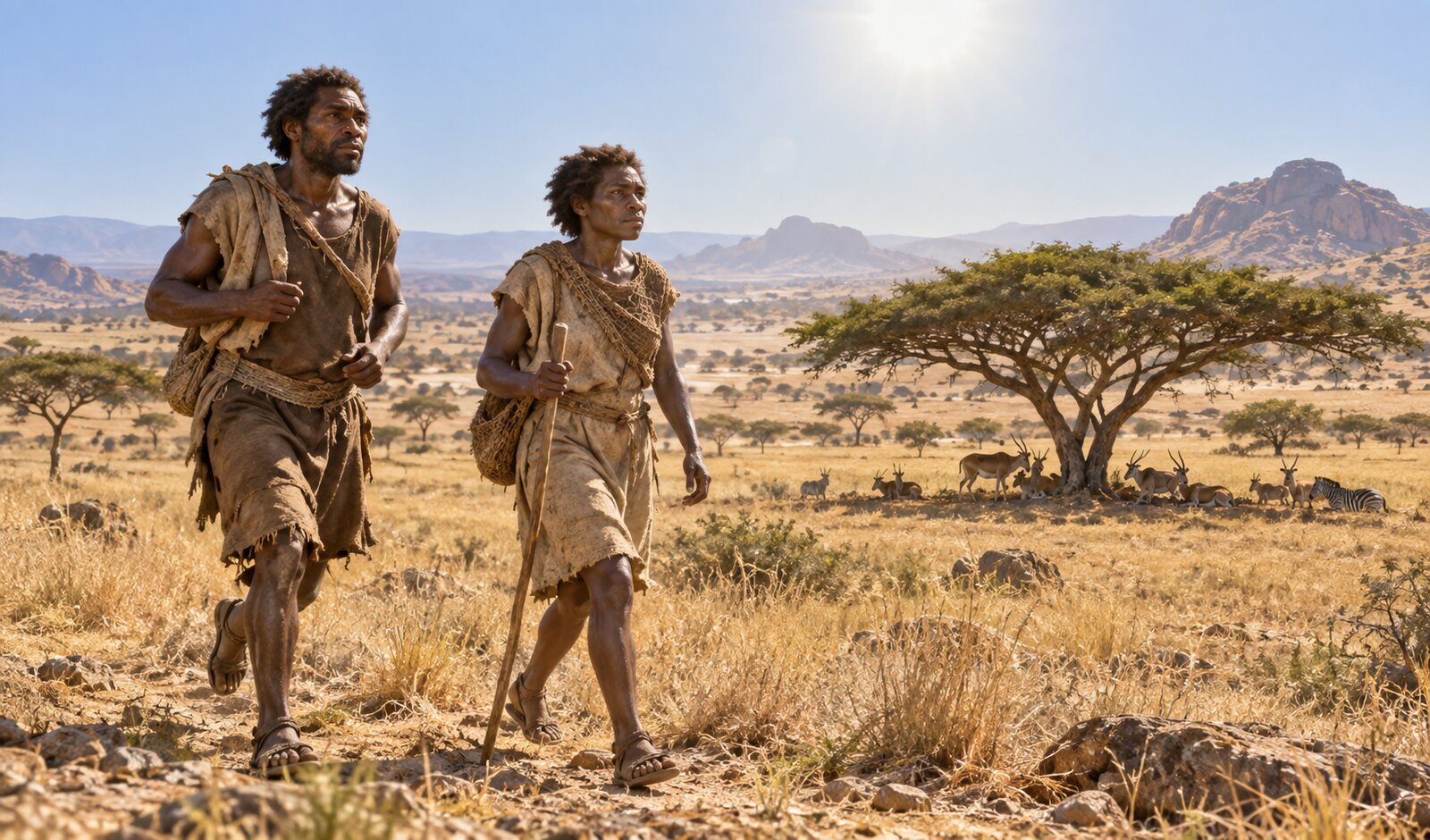
Most mammals cool themselves mainly by panting, seeking shade or reducing activity. Humans possess another remarkable option: we can cover nearly our entire bodies with watery sweat.
As sweat evaporates, it removes heat directly from the skin. This allows a person to keep walking, running or gathering food in temperatures that force many animals to rest. Reduced body hair makes evaporation more effective.
The strongest comparative evidence comes from researchers who examined skin samples from humans, chimpanzees and macaques. Human skin contained approximately ten times as many eccrine sweat glands as the other primates. Surprisingly, chimpanzees possessed these glands across their bodies too; human evolution dramatically increased their density rather than inventing an entirely new cooling system. Comparative study
A broader analysis of 35 primate species found that greater eccrine-gland density was associated with hotter, drier environments—evidence that climate helped shape sweating capacity through natural selection. Primate study
Well supported: humans have an exceptional capacity for whole-body sweating, and evaporation helps us remain active in heat. Our sparse body hair and dense sweat glands form a powerful cooling combination.
Plausible but debated: this system evolved specifically for endurance running and persistence hunting. Sweating could also have supported long-distance walking, scavenging, gathering or any daytime activity in exposed landscapes. Sweat glands do not fossilize, so researchers cannot determine exactly when or for which behavior the transformation occurred.
Our evolutionary advantage was not simply a larger brain or better tools. Sometimes it was the ability to keep moving while everything else searched for shade.


