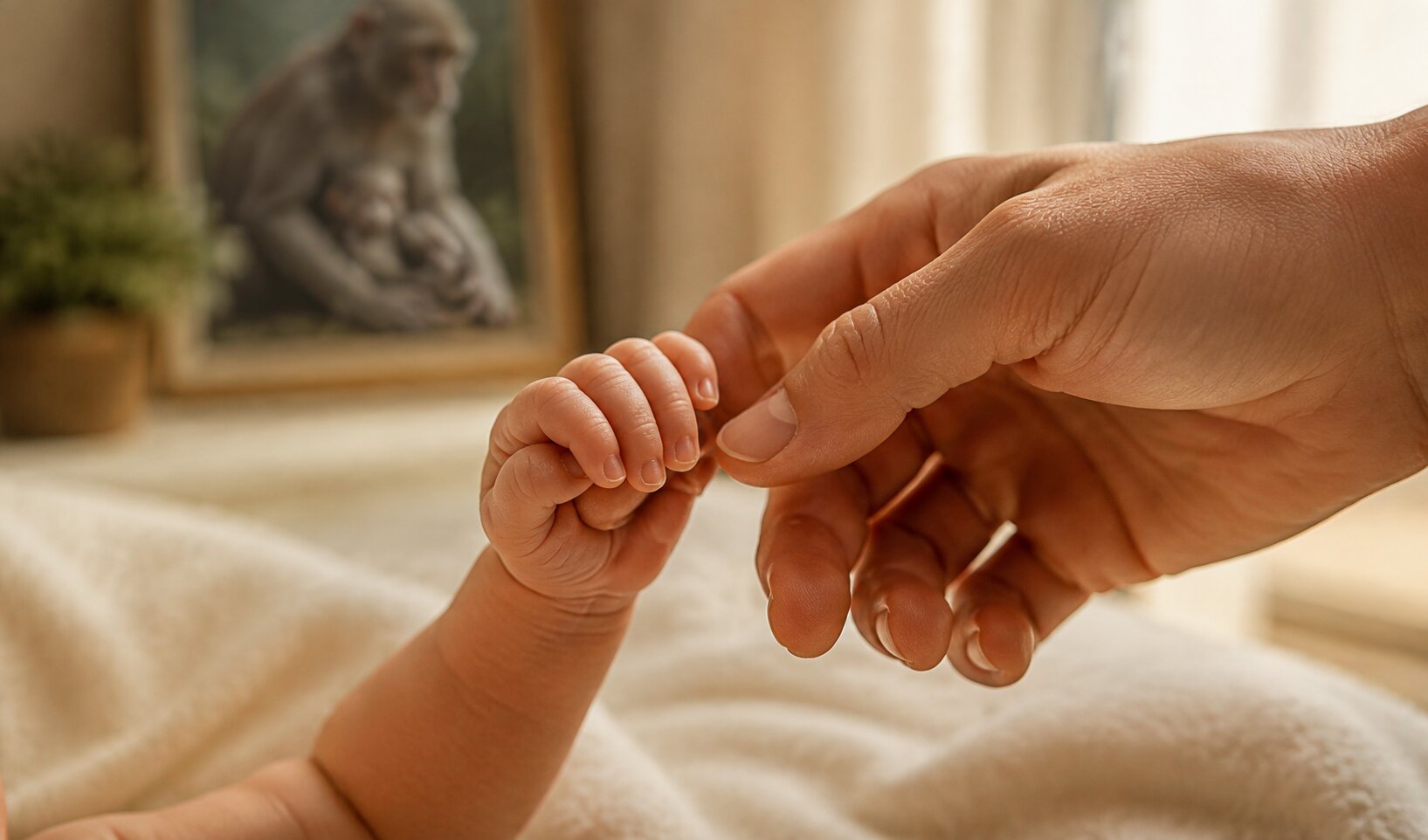
Place a finger in a newborn’s palm and the tiny hand closes with surprising force. It feels affectionate, but the baby is not choosing to hold on. Pressure activates the palmar-grasp reflex—an automatic response present even before birth.
In many primates, gripping is vital. Infants cling to their mother’s fur while she climbs and searches for food, leaving her hands free. Human babies are carried rather than expected to support themselves, yet they retain similar ancient motor circuitry.
The strongest comparative evidence comes from research on 21 primate species. Species whose infants ride by grasping fur displayed substantially greater hand use and dexterity than species whose mothers carried infants in their mouths. Evolutionary reconstruction indicated that fur-clinging arose independently at least three times, suggesting a close relationship between infant transport and grasping ability.
Well supported: the human reflex begins prenatally and normally fades by four to six months as maturing brain systems increasingly control the spinal circuitry and voluntary grasping develops. Its timing makes it a useful indicator of neurological development.
Plausible but debated: our reflex survives specifically because ancestral babies once clung to body hair. The shared primate pattern makes that explanation credible, but it cannot show precisely what happened along the human lineage. The reflex might also persist because it supplies a useful developmental foundation for later hand control.
A newborn’s grip may therefore be both a developing brain’s first motor program and an echo of infants who once traveled by holding on.


