“Broadcast” Began in a Farmer’s Field
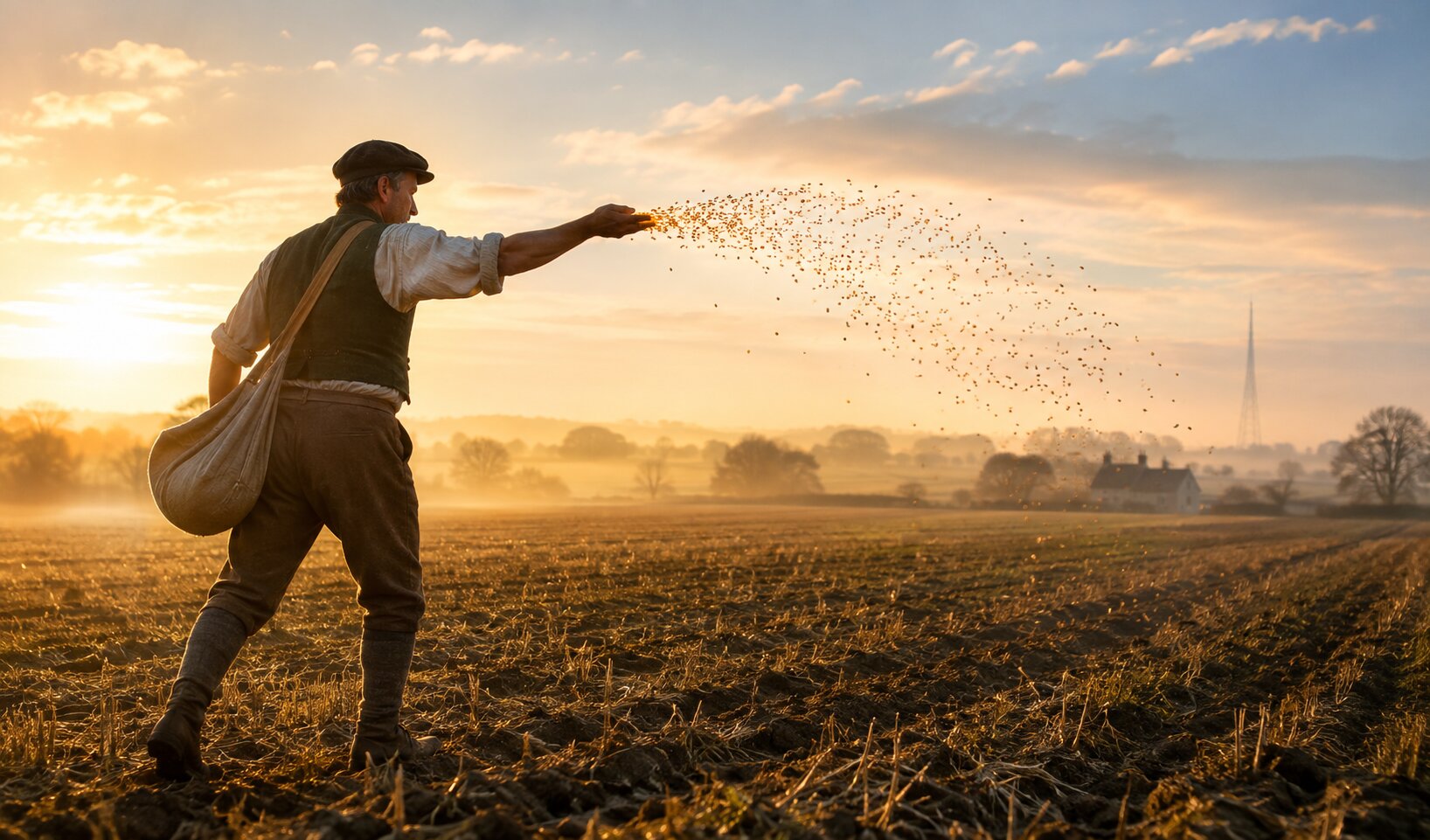
Long before anyone broadcast news, music, or television, farmers were broadcasting seeds.
The word combines broad with cast, meaning “to throw.” Beginning in the eighteenth century, to broadcast meant to scatter seeds widely by hand rather than plant them carefully in rows. A farmer would reach into a bag and cast grain in a sweeping arc across the soil.
Then technology borrowed the farming metaphor.
When radio developed in the early twentieth century, engineers needed a word for transmitting one signal outward to many listeners. Broadcast fit beautifully: invisible radio waves were scattered across a wide area, like seeds over a field.
The agricultural sense became less familiar, while the communication sense flourished. The word expanded from radio to television and eventually to emails, live internet video, and messages sent to large groups.
Here is the memorable connection: the audience is linguistically a field, the transmitter is the farmer, and every program or message is a handful of seed—scattered widely in the hope that some of it will take root.
So when someone broadcasts an idea, they are still farming—only now, the crop grows in human minds.