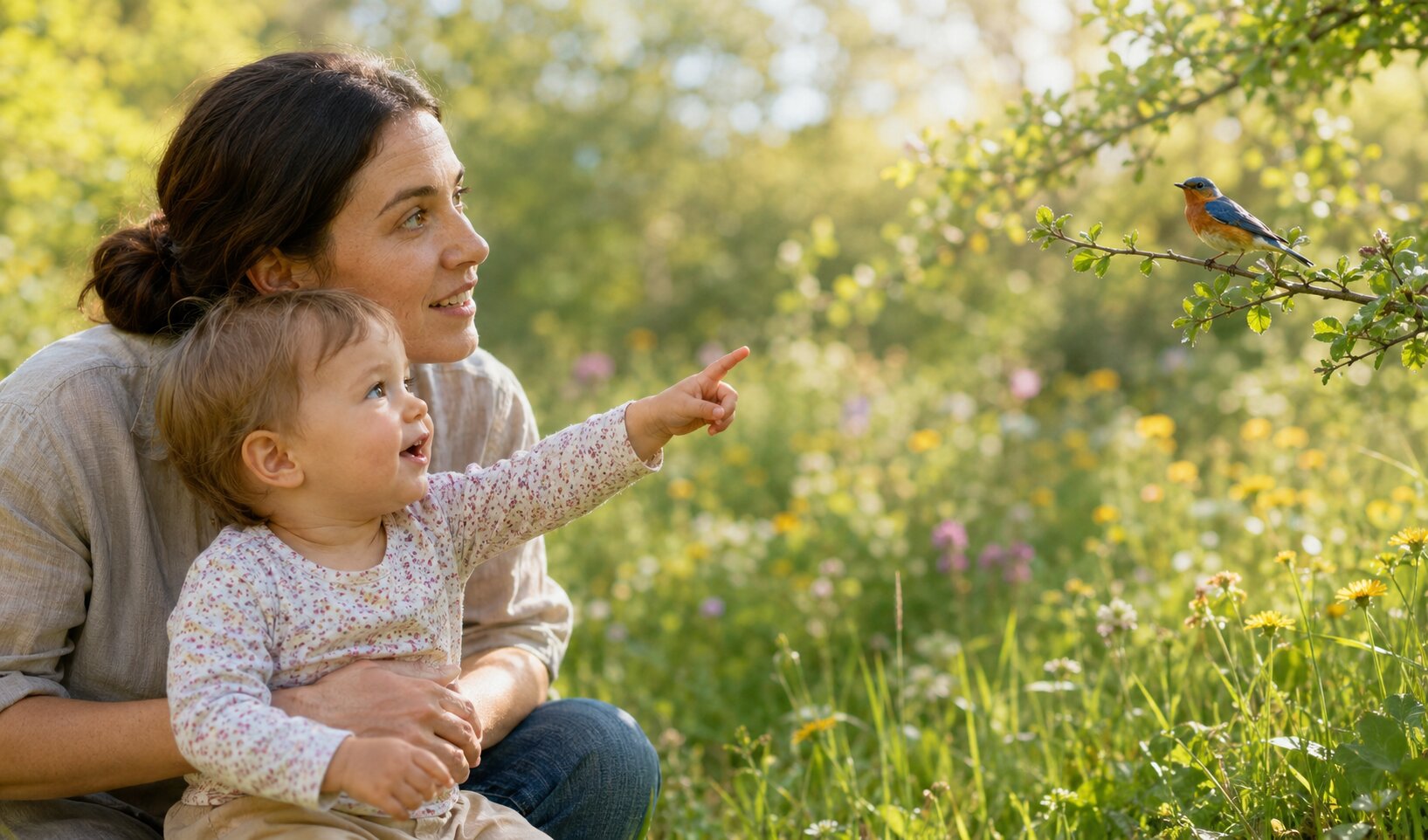
The Tiny Gesture That May Have Opened the Door to Language
Around their first birthday, babies begin performing a remarkable act: they point—not only to request something, but simply to share attention.
A child sees a bird, points, and checks whether you are looking too. This creates joint attention: two minds focusing on the same thing while knowing they are sharing the experience. It gives caregivers perfect opportunities to supply words—“Yes, a bird!”—when the child is already interested.
The strongest evidence is developmental. Longitudinal studies show that the variety of meanings children express through gestures at 18 months predicts vocabulary at 42 months, even after accounting for their early speech. Gesture-and-word combinations also predict later sentence complexity.
Well supported: pointing and joint attention emerge before fluent speech and reliably predict later language development.
Plausible but debated: cooperative pointing was an evolutionary stepping-stone toward human language. Great apes gesture extensively, but they usually point to obtain something; spontaneous pointing merely to share interest appears much rarer. However, ape behavior changes with upbringing and communicative experience, so the human–ape divide is not absolute.
Before children can say, “Look at that,” one small finger already conveys the idea.