When you get your cholesterol checked, you are actually looking at lipoproteins. Because cholesterol is a fat, it cannot travel through your watery bloodstream on its own. It needs to be carried inside tiny spherical transport pods made of lipids (fats) and proteins.
LDL and HDL are the two main types of these transport packages, and they travel in opposite directions.
1. LDL: Low-Density Lipoprotein (“Bad” Cholesterol)
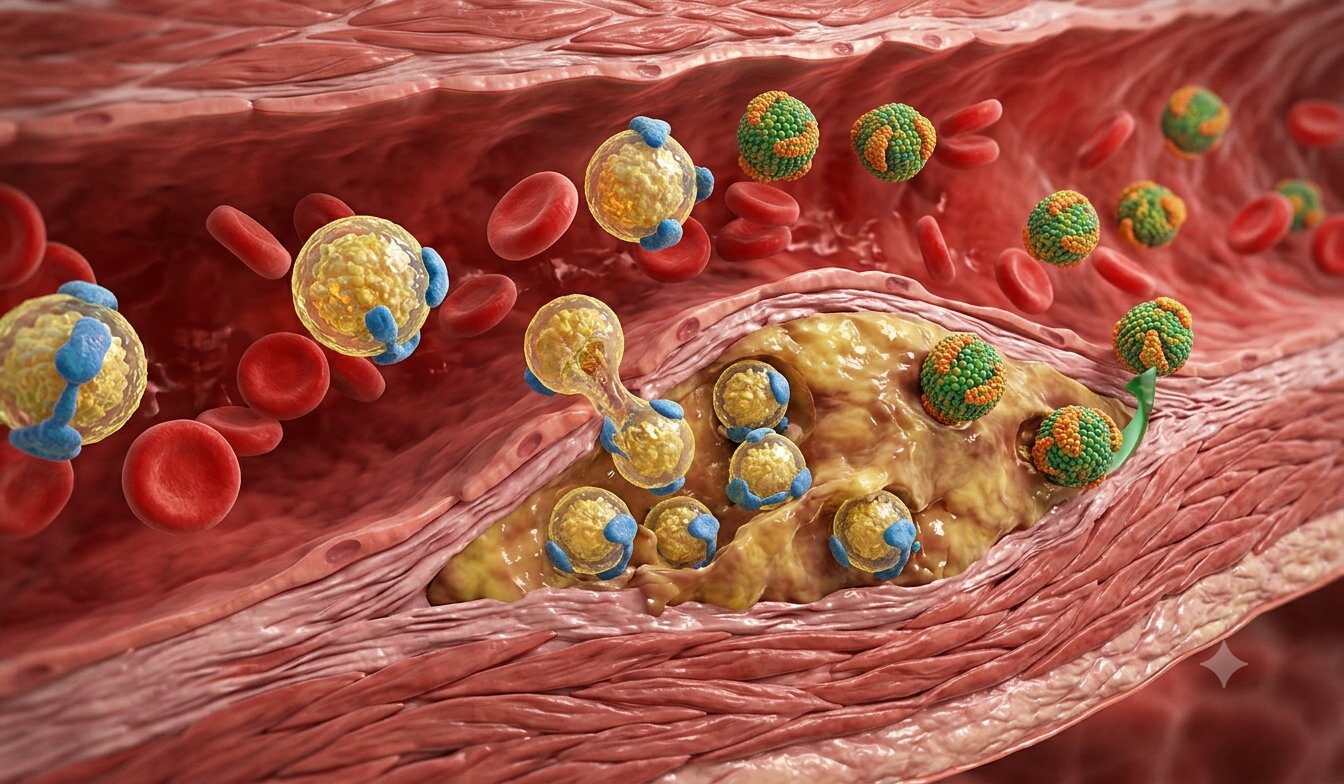
Think of LDL as the delivery trucks.
-
The Job: LDL takes cholesterol produced by your liver and carries it through your bloodstream to the cells and tissues that need it to build cell membranes and hormones.
-
The Problem: If there is too much LDL floating around, or if the trucks become damaged (oxidized), they tend to dump their cargo inside your artery walls. Over time, this builds up into a hard, fatty substance called plaque. This narrowing of the arteries (atherosclerosis) restricts blood flow and increases the risk of heart attacks and strokes.
-
Target: Lower is generally better.
2. HDL: High-Density Lipoprotein (“Good” Cholesterol)
Think of HDL as the cleanup crew or vacuum cleaners.
-
The Job: HDL roams the bloodstream, picking up excess, unused cholesterol from your tissues and artery walls.
-
The Destination: It carries this extra cholesterol back to the liver, which breaks it down and safely flushes it out of the body through bile.
-
The Benefit: Because HDL actively removes cholesterol from places it shouldn’t be, higher levels of HDL are associated with a protective effect against heart disease.
-
Target: Higher is generally better.
Quick Comparison
| Feature | LDL (Low-Density) | HDL (High-Density) |
| Common Nickname | “Bad” cholesterol | “Good” cholesterol |
| Primary Direction | From the liver $\rightarrow$ out to the body | From the body $\rightarrow$ back to the liver |
| Impact on Arteries | Can deposit fat and build up plaque | Removes excess fat and prevents plaque buildup |
| Cardiovascular Risk | High levels increase heart disease risk | High levels help lower heart disease risk |
While the “good vs. bad” labels make it simple to understand, your body actually needs both to function. The key to cardiovascular health is keeping them in a healthy balance.